School Wellness Policy
This chapter provides guidance for supporting student wellness through school policies that promote healthy nutrition, physical activity, and safe learning environments.
Federal Legislation
To address obesity and promote healthy eating and physical activity among students in school environments, Congress passed the Child Nutrition and Women, Infants, and Children’s Reauthorization Act of 2004 (Sec. 204 of Public Law 108-265). This Act requires every school district that participates in federal school meal programs to enact a wellness policy by the first day of the 2006–2007 school year.
Congress subsequently passed the Healthy, Hunger-Free Kids Act of 2010 (Sec. 204 of Public Law 111-296), adding new provisions related to implementation, evaluation, and public reporting on progress of local school wellness policies.
This Act requires local education agencies (LEAs) participating in the National School Lunch Program (or other Child Nutrition programs) to establish a local school wellness policy for all schools under its jurisdiction and to designate one or more school officials to ensure that each school complies with the wellness policy. At a minimum, local school wellness policies must:
- Include goals for nutrition promotion, nutrition education, physical activity, and other school-based activities that promote student wellness.
- Include nutrition guidelines for all foods available in each school district to support student health and reduce childhood obesity.
- Permit parents, students, school food authorities, physical education teachers, school health professionals, school boards, school administrators, and the general public to participate in policy development and review.
- Inform and update the public regarding the content and implementation of local wellness policies.
- Be measured periodically and make assessment results available to the public.
The Healthy, Hunger-Free Kids Act of 2010 further directed the USDA to establish science-based nutrition standards for all foods and beverages sold to students during the school day. The USDA’s Smart Snacks in School standards were implemented in 2014–2015.
The New Mexico Public Education Department (PED) school district wellness policy requirements support the premise that providing comprehensive school health services is essential to the academic success and lifelong well-being of students in New Mexico.
New Mexico Administrative Code
In keeping with the federal legislation, New Mexico updated its School District Wellness Policy and Nutrition Rules within the State Administrative Code.
The Nutrition Rule stipulates compliance with federal laws, rules, and guidance for school meal programs, limits the number of fundraisers to one school day per semester, and specifies that no fundraiser may compete with school meals in food service areas.
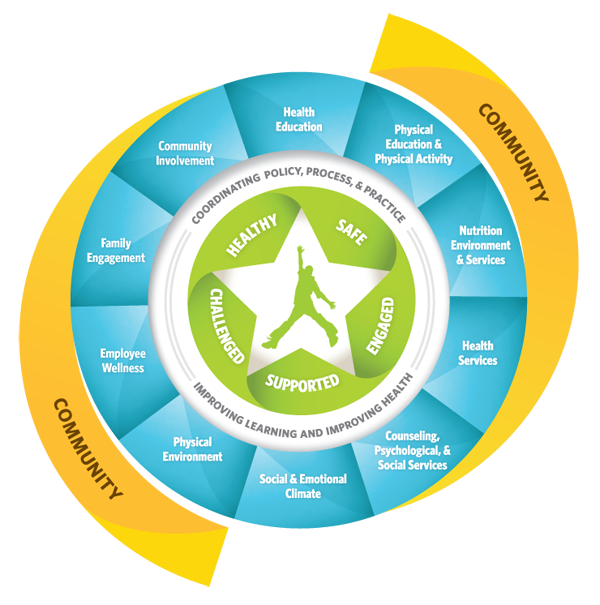
The School District Wellness Policy rule expands on federal mandates and requires the development of implementation guidelines for the other six components of coordinated school health in New Mexico. These ten total components are represented by the Whole School, Whole Child, Whole Community model of coordinated school health in New Mexico.
Whole School, Whole Community, Whole Child Model
Policy Development Tools
The CDC Wellness Policy website contains formation and implementation guides, resources, and documents to assist with all aspects of the wellness policy process.
When developing policies, school districts should consider unique circumstances, challenges, and opportunities in their communities, including:
- Socioeconomic status of the student body
- School size
- Rural or urban location
- Presence of immigrant, dual-language, or limited-English-speaking students
It may also be helpful to use local district data such as nursing referrals, chronic absenteeism, and county-level health data.
- Childhood Obesity Report — New Mexico Department of Health, 2020 https://www.nmhealth.org/news/awareness/2020/6/?view=1030.
- The Weight of Our Children — New Mexico Department of Health, 2019 https://www.nmhealth.org/data/view/chronic/2381/.
- Youth Risk and Resiliency Survey https://youthrisk.org/.
Policy Development Guidelines
The following steps will assist in moving through the policy development process.
- In New Mexico, each district board of education is charged with establishing a district school health advisory council (SHAC) with broad representation. It is the responsibility of this body to meet at least twice a year and make recommendations to the local school board in the development/revision, implementation, and evaluation of the district's wellness policy. It is the school board’s/district’s responsibility to designate who will be charged with the operational responsibility of ensuring that each school fulfills the wellness policy requirements.
-
The SHAC is responsible for drafting a wellness policy that addresses the following:
- Health education: K–12 curriculum aligned with PED standards and benchmarks;
- Physical education: K–12 curriculum aligned with PED standards and benchmarks;
- Physical activity: Guidelines for before, during, and/or after school opportunities;
- Nutrition: Guidelines for meeting federal and state requirements (see above);
- Behavioral health: Plan for addressing the behavioral health needs of students by focusing on their social and emotional well-being;
- School safety: Plans at each school building focused on supporting healthy and safe learning environments (policies/procedures, prevention, and emergency response), though this is addressed by school site safe schools plans which are evaluated separately from the wellness policy;
- Health services: Plan that addresses health services needs of students in the educational process;
- Staff wellness: Plan addressing staff wellness that minimally ensures an equitable work environment and meets the American with Disabilities Act;
- Implementation and Evaluation: Plan for measuring implementation and evaluation of the wellness policy, including designation of one or more persons charged with operational responsibility for ensuring that each school fulfills the district’s wellness policy.
- When completed, the wellness policy should be presented to the school board or appropriate body/person in the individual school district for approval and adoption as policy.
- Once adopted by the school district, the policy, with its evaluation plan, is submitted to the PED.
- Districts are required by the PED to monitor their wellness policy and evaluate it annually.
Resources and References
-
Action for Healthy Kids.
https://www.actionforhealthykids.org/ -
Alliance for a Healthier Generation.
https://www.healthiergeneration.org/ -
Center for Ecoliteracy.
http://www.ecoliteracy.org/ -
Centers for Disease Control and Prevention, Division of Adolescent and School Health.
Adolescent and School Health | CDC -
Child Nutrition and WIC Reauthorization Act of 2004, Public Law 108-265.
S.2507 — Child Nutrition and WIC Reauthorization Act of 2004 -
Fair Food Network.
https://fairfoodnetwork.org/ -
Farm to School.
http://www.farmtoschool.org/ -
New Mexico Grown.
https://www.farmtotablenm.org/programs/healthy-kids-healthy-economy/ -
Healthy, Hunger-Free Kids Act of 2010.
Local School Wellness Policy Implementation Under the Healthy, Hunger-Free Kids Act of 2010 -
Healthy Kids New Mexico.
http://archive.healthykidsnm.org/ -
National Alliance for Nutrition and Activity.
https://www.cspinet.org/protecting-our-health/nutrition/national-alliance-nutrition-and-activity -
New Mexico Administrative Code for School District Wellness Policy.
https://www.srca.nm.gov/parts/title06/06.012.0006.html -
New Mexico Administrative Code for Nutrition: Implementation of Federal Requirements for Competitive Foods Schools.
https://www.srca.nm.gov/parts/title06/06.012.0005.html -
New Mexico PED Safe and Healthy Schools Bureau Wellness Policy.
https://webnew.ped.state.nm.us/bureaus/safe-healthy-schools/wellness-policy/ -
Smart Snacks at School.
https://www.fns.usda.gov/cn/smart-snacks-school -
Team Nutrition: Local Wellness Policy.
https://www.fns.usda.gov/team-nutrition -
Youth Risk and Resiliency Survey.
http://youthrisk.org/