Guidelines for Do Not Attempt to Resuscitate Order Policy for the School Setting
This chapter provides guidance for Do Not Attempt to Resuscitate order policies in the school setting, including documentation, communication, emergency response planning, and coordination among school personnel and health care providers.
Introduction
The term DNR (Do Not Resuscitate) order usually is defined as a medical directive by an ordering healthcare provider that cardiopulmonary resuscitation (CPR) is not to be used on an identified individual in the event of a cardiac or respiratory arrest. DNR is now referred to as DNAR (Do Not Attempt Resuscitation). This does not mean that a DNAR order for a student is automatically binding if presented to a school district/administration.
Situations in which DNAR orders are presented in the schools are often challenging to all concerned. This is identified well in the policy statement by the American Academy of Pediatrics: “These decisions challenge all persons involved in a situation in which CPR may be given to balance personal beliefs, strong feelings, legal concerns especially those having to do with liability, educational considerations, and other issues” [Committee on School Health and Committee on Bioethics. (2000). Do not resuscitate orders in schools. Pediatrics 105(4): 878–879, 10.1542/peds.105.4.878].
It is the position of the National Association of School Nurses (NASN) that each student with a Do Not Attempt Resuscitation (DNAR) order benefits from having an Individualized Healthcare Plan (IHP) and an Emergency Care Plan (ECP) developed by the registered professional school nurse.
Although every school district should have and allow a DNAR protocol, some do not have one or do not recognize DNAR orders. In those cases, the School Nurse needs to meet with the family and ask what the family wishes are, get orders from the medical provider, and alert EMS in their area. Each school district or school board can determine DNAR protocols for their district. The School Nurse should refer to the school board policies and procedures for the district.
Before any school district establishes a policy or procedure for DNR/DNAR, or responds to any specific situation, it is imperative the district closely reviews state statutes with a multidisciplinary approach. The multidisciplinary task force should include, at a minimum, the parents, educators, legal representatives, local EMS advisor, support personnel, and health-care staff from the community.
Once district policy has been set, educating all those who may be involved in response to a DNAR order is a critical step. Sample policy options are included in this document. Also included is a sample procedure for implementing a DNAR order in a school.
State of New Mexico Policy for Advance Directives
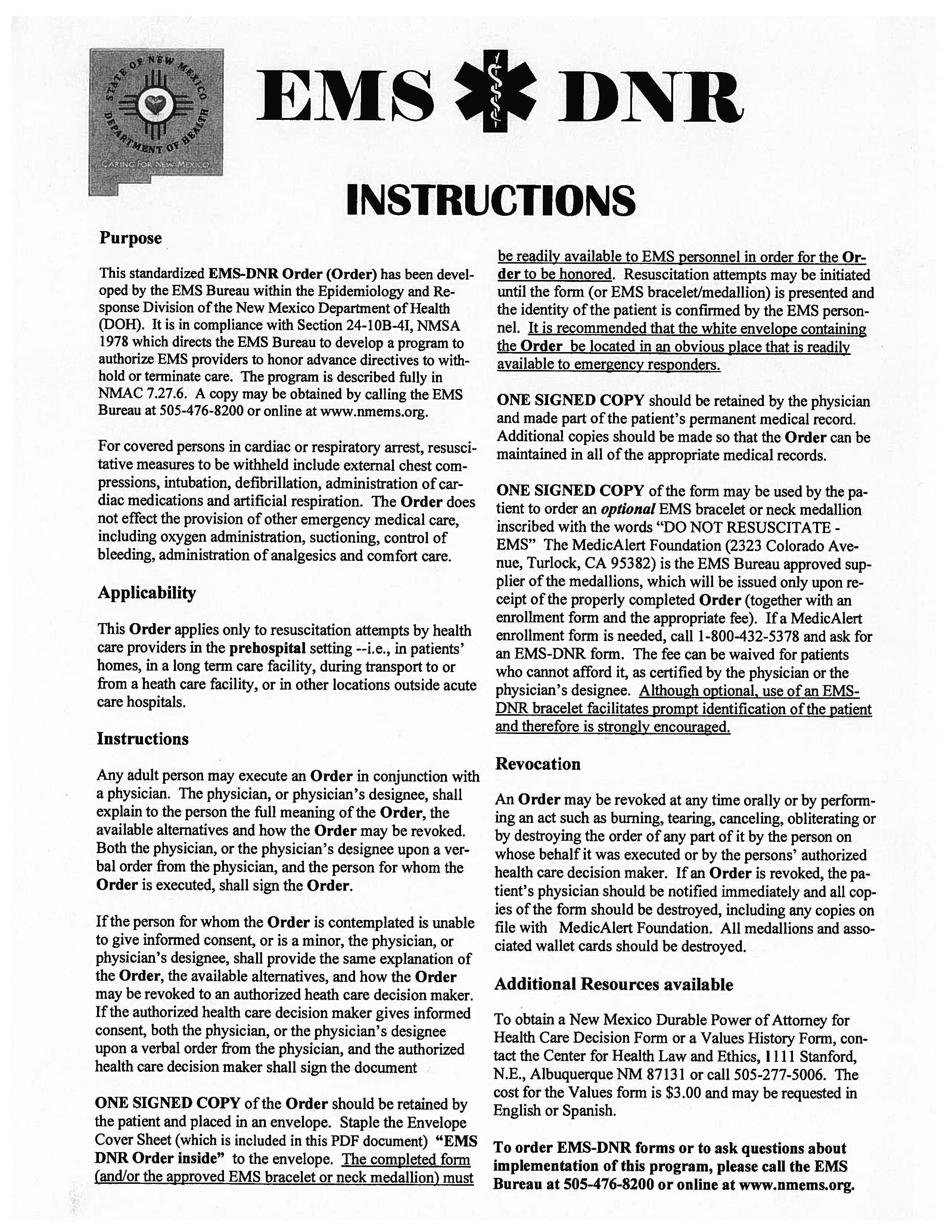
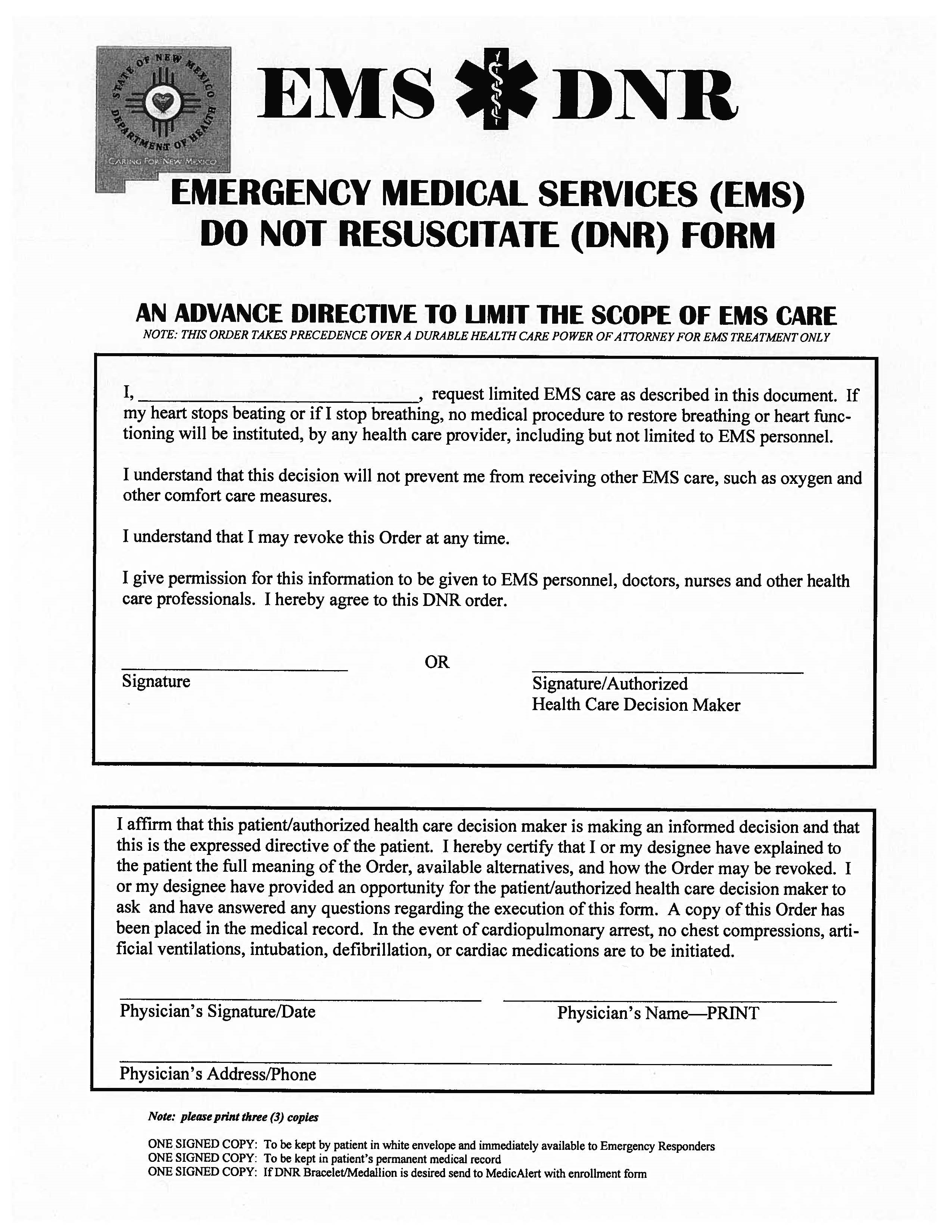
New Mexico code NMAC § 7.27.6 for EMS advance directives in New Mexico that govern the management of DNAR orders are very clear. These directives include honoring DNAR orders from other states if the order is following the laws of New Mexico. Below are highlights of this statute:
- Any physician, advanced practice nurse, or PA may execute an EMS DNR order on behalf of any person with capacity, with the person's informed consent.
- The physician, advanced practice nurse, PA, or designee must explain to the person the full meaning of the order, the available alternatives, how the order may be revoked, and answer any questions the person may have about the order.
- The person for whom the order is being executed shall sign the document, as well as the physician, advanced practice nurse, or PA.
- A registered nurse may sign the EMS DNR or MOST if a verbal order for the EMS DNR or MOST has been received from a physician, advanced practice nurse, or PA; the name of the physician, advanced practice nurse, or PA must be printed beneath the signature.
- If the person for whom an EMS DNR order is contemplated has appointed an agent under a durable power of attorney, and the person lacks capacity, the physician, advanced practice nurse, PA, or designee may discuss the situation with the person’s authorized health care decision maker, if any.
- The physician, advanced practice nurse, PA, or designee shall explain to the authorized health care decision maker the full meaning of the order, the available alternatives, how the order may be revoked, and answer any questions the authorized health care decision maker may have about the order.
- If the authorized health care decision maker gives informed consent to the order, the decision maker will sign the EMS DNR or MOST, as will the physician, advanced practice nurse, or PA.
- An EMS DNR or MOST order shall remain in effect indefinitely unless revoked or unless an expiration date is specified in the document.
- An EMS DNR or MOST order shall be periodically reviewed by the person for whom the EMS DNR order is executed or by the authorized health care decision maker.
- A person for whom an EMS DNR order is executed may choose to wear an optional EMS bracelet indicating the existence of the order.
- An EMS DNR or MOST order may be revoked at any time orally, by executing a subsequent order, or by performing an act which indicates an attempt to revoke the order, such as burning, tearing, canceling, obliterating, or destroying the order or any part of it.
- If an EMS DNR or MOST order is revoked, EMS personnel shall initiate appropriate resuscitation measures.
- Any adult with decisional capacity may execute a durable power of attorney.
- A durable power of attorney shall remain in effect indefinitely unless revoked or unless an expiration date is specified in the document.
- A durable power of attorney may be revoked at any time by executing a subsequent durable power of attorney, performing an act that indicates an attempt to revoke the document, or by an oral statement by the person who executed it.
For all persons, the following procedures may be initiated for comfort if they have not been refused by the person or by the authorized health care decision maker:
- Administering oxygen by mask or cannula.
- Suctioning.
- Managing airways except intubation and other advanced airway maneuvers.
- Administering analgesics, as authorized by the New Mexico scopes of practice.
- Controlling bleeding.
- Making the patient comfortable.
- Comforting family.
For all persons in cardiac or respiratory arrest, the following procedures shall be withheld:
- External cardiac compressions.
- Artificial ventilations, intubation, or other advanced airway maneuvers.
- Defibrillation/external cardiac pacing.
- Administration of cardiac medication.
- Artificial respiration.
If there is any question about the validity of an EMS DNR order, or there is evidence of an attempted homicide or suicide, initiate resuscitation until such time that the questions have been answered.
Sample Policy Guidelines for Do Not Resuscitate (DNAR) Orders
When a DNAR order for a student is presented to the School District, the following criteria must be met:
- An original of the healthcare provider’s order with original signatures, the state Emergency Medical Services (EMS) DNAR form, and the school district DNAR form, if applicable, must be completed by the physician and the parent(s)/legal guardian(s) and submitted to the school. Copies are not acceptable.
- If a student is 18 years of age or older, the DNAR forms must be signed by the student unless custody of the student has been legally awarded to a guardian.
- DNAR order is to be presented to the school principal and/or the school nurse who will initiate the following procedures:
- The school district nursing coordinator, if applicable, and the superintendent or designee are to be informed when a school has received a DNAR order. Along with the DNAR order, the school should submit the School Nurse’s review and any identified concerns with the order.
- A team meeting should be arranged with the parent(s)/guardian(s), the local EMS providers, and appropriate school staff and health providers to outline expectations and procedures.
- A plan of care consistent with the DNAR orders will be developed to include goals, outcomes, and delegation of care in the student’s Individualized Healthcare Plan (IHCP).
- The IHCP can only be developed and signed by the school nurse in collaboration with the parent(s)/guardian(s) and will be reviewed at the beginning of each semester as part of the Individual Education Plan (IEP) and/or 504 plan and updated as needed.
- Proceedings are to be documented in the student’s health record.
- The health-care provider’s order, EMS DNAR form, and school district DNAR form must be documented on the student’s Emergency Card and submitted to the District Nursing Coordinator, if applicable.
- DNAR orders are to be reviewed each semester and as part of each IEP or 504 plan.
- Maintain student confidentiality. Only school staff with a legitimate need-to-know will be informed of the DNAR order.
- Advise parent(s)/guardian(s) that anyone who is not directly informed about the DNAR order will otherwise follow school district policy and initiate resuscitation.
The School Nurse will be responsible for ensuring that all staff members who are informed of the DNAR order are trained to follow the expected procedures as delineated in the student’s health care plan.
Guidelines for Procedure for Implementing a DNAR Order
If a student with a DNAR order has a cardiac or respiratory arrest at school, the following process should be implemented:
- Activate EMS.
- Provide comfort measures and any other medical intervention allowable under the DNAR order and healthcare plan.
- Contact parent(s)/guardian(s).
- Isolate student and maintain as normal an atmosphere as possible in the school or at the site.
- Contact prescribing provider for DNAR order.
- If a student with a DNAR order dies while at school, the school principal or designee will inform the police and ensure that the Office of the Medical Investigator (OMI) is notified as soon as possible, as well as the Superintendent and the District Nursing Coordinator, if applicable. The body may not be moved until authorized by OMI.
Grief counseling resources for school employees and for students should be made available as soon as possible, and the school district crisis response team should be activated immediately to provide assistance at the school.
Revocation of a DNAR Order
The DNAR order may be revoked at any time by the physical destruction of the DNAR order with the consent of the authorized decision-maker or delivery of an oral statement by the authorized decision-maker to resuscitate. Staff who have been informed about the original DNAR order should be informed of the revocation of any DNAR order, and documentation of the revocation will be made on the student’s health record.
Example Policy for DNAR Order
It is the policy of the school district Board of Education to provide all students with immediate first aid and emergency rescue services as appropriate.
Definition of DNAR Orders
DNAR orders in the school setting means a parent/guardian’s wish and a health-care provider’s written request to withhold life-saving techniques or resuscitative measures in the event of a respiratory or cardiac arrest suffered by a severely-impaired or terminally-ill student. A competent student who is 18 years of age or older or an emancipated minor may provide consent for the DNAR order in lieu of a parent/guardian.
Accepting DNAR Orders
DNAR orders presented to the school district by a parent or guardian on behalf of his/her minor child will be considered on a case-by-case basis through health services and student support services. Appropriate accommodations will be established and documented in the student’s Individualized Educational Plan or 504 Plan.
Implementing DNAR Orders
The Board of Education policy will be fully explained to the parent/guardian who presents DNAR orders by school administration and the following procedure will be followed.
- The School Nurse will meet with the parent/guardian and initiating health-care provider to determine the student’s medical diagnosis, current medical condition, prognosis, and anticipated medical needs.
- A multidisciplinary team meeting will then be convened to develop a health management plan for the student, which will include a medical resuscitation plan and individually appropriate life-sustaining intervention steps to be followed in a medical emergency at school.
- If the DNAR authorizing parent/guardian declines to meet with the team or declines to agree to a health management plan following the school district policy, the DNAR order will be declined by the school district and documented in the student’s file.
- All school personnel who have been trained in emergency cardiopulmonary resuscitation (CPR) are expected to administer first aid, including life-saving or resuscitation procedures, to any student, with or without a DNAR order, in the event of an accident, choking, respiratory and/or cardiac arrest, or any other life-threatening emergency.
- Community Emergency Medical Services (EMS) at 911 will be called immediately when a life-threatening situation presents, and school personnel will continue resuscitation efforts until relieved by EMS who will be provided with the original DNAR orders on file at the school.
Once transport of the student from the school begins, DNAR orders become the responsibility of the transporting team/individual, whether that be the parent/guardian or EMS.
Adapted from policies of Raton Public Schools and Clovis Municipal Schools.
Example DNAR Procedure
If a student with a Do Not Resuscitate order has a cardiac or respiratory arrest at school, the following shall be implemented:
Presentation of a Do Not Resuscitate Order to the District
In order for the school to recognize a Do Not Resuscitate Order as legally binding and valid, the order must be presented to the Manager of Nursing Services, the School Nurse, and the school principal and must meet the following requirements:
- An original of the health-care provider's Do Not Resuscitate order, the state Emergency Medical Services (EMS) Do Not Resuscitate form, and the school Do Not Resuscitate form must be completed by the physician and the parent(s)/legal guardian(s). All forms must be the original document; copies are not acceptable.
- Upon turning eighteen (18) years of age, the student shall be required to grant Do Not Resuscitate authorization unless custody of the student has been legally awarded to a guardian.
Upon receipt of a Do Not Resuscitate order, the school principal and the licensed School Nurse shall immediately initiate the following procedures:
- The Nursing Services manager and the superintendent, or his/her designee, shall be informed that a Do Not Resuscitate order was received.
- The Nursing manager and the superintendent, or his/her designee, shall receive the licensed school nurse's review, a copy of the Do Not Resuscitate order, and any identified concerns with the order.
- Upon receiving a Do Not Resuscitate order, a conference shall be arranged with the parent(s)/legal guardian(s), the local Emergency Medical Service providers, and appropriate school staff and health providers to outline expectations and procedures.
- A plan of care, which follows the health-care provider's orders, shall be developed and include goals, outcomes, and delegation of care to be addressed in the student's Individualized Healthcare Plan. The health-care plan shall be written by the licensed School Nurse in collaboration with the parent(s)/legal guardian(s) and shall be reviewed and updated as needed at the beginning of each semester. If the student receives special education services, the health-care plan shall be reviewed as part of the student's Individual Education Plan and/or 504 Plan and updated as needed. All proceedings shall be documented in the student's health record.
- The health-care provider's order, Emergency Medical Services Do Not Resuscitate form, and School Do Not Resuscitate form shall be documented on the student's emergency contact card and submitted to the Schools Nursing Services manager.
- Student confidentiality shall be maintained as much as possible. Only school staff with a legitimate need-to-know shall be informed of the Do Not Resuscitate order. The parent(s)/legal guardian(s) shall be advised that anyone who is not directly informed about the Do Not Resuscitate order shall otherwise follow school policy and procedural directives and initiate resuscitation.
- The School Nurse/school nurse practitioner shall be responsible for ensuring that all staff members who are informed of the Do Not Resuscitate order are trained to follow the expected procedures as delineated in the student's health care plan.
Procedures for Implementing a Do Not Resuscitate Order
- Activate Emergency Medical Services.
- Contact the parent(s)/legal guardian(s).
- Isolate the student and maintain as normal an atmosphere as possible in the school or site.
- Contact the health-care provider who wrote the Do Not Resuscitate order.
- If a student with a Do Not Resuscitate order dies while at school, the school principal or designee shall inform the Office of the Medical Investigator, superintendent, New Mexico Department of Health, and the Albuquerque Public Schools Nursing Services manager as soon as possible. The body shall not be moved until authorized by the Office of the Medical Investigator.
- Grief counseling resources for school employees may be obtained from the Employee Assistance Program, and for students, from the Health and Wellness Counseling Team.
- When appropriate, the District Crisis Counseling Team may be activated to provide assistance at the school.
Revocation of a Do Not Resuscitate Order
A Do Not Resuscitate order may be revoked at any time by:
- Physical destruction of the Do Not Resuscitate order form with the consent of the authorized decision-maker; or
- An oral statement by the authorized decision-maker to resuscitate.
Staff informed about the original Do Not Resuscitate order shall be informed of its revocation. Record of the revocation shall be made on the student's health record. The Nursing Services manager shall be informed, in writing, of the revocation of the Do Not Resuscitate order.
Administrative Position: Assistant Superintendent of School and Community Support Department Director: Director of Health and Wellness/Manager of Nursing Services References: Legal Cross Ref.: Individuals with Disabilities Act Board Policy Cross Ref.: JL3 - Emergency Medical Services and Do Not Resuscitate Orders Procedural Directive Cross Ref.
Example DNAR Forms
Download the DNR Order Sample.
Resources and References
-
Do Not Attempt Resuscitation (DNAR) Orders in School Settings: Special Needs School Nurses Review, Current Research and Issues,
NASN School Nurse, Vol. 28, No. 2, pp. 71–75. -
Do Not Resuscitate Orders in Schools, Committee on School Health and Committee on Bioethics.
Pediatrics Apr 2000, 105(4) 878–879; DOI:
10.1542/peds.105.4.878 -
National Association of School Nurses (NASN). Do Not Attempt Resuscitation (DNAR) – The Role of the School Nurse. January 2014.
View resource -
NMAC § 6.41.4.8
Responsibilities of the Local Board of Education or Charter School Administrator. -
Honoring Do-Not-Attempt-Resuscitation Requests in Schools, Council on School Health and Committee on Bioethics.
Pediatrics May 2010, 125(5) 1073–1077; DOI:
10.1542/peds.2010-0452